Welcome back to the Banking Brief. This week: The banking layoffs are getting pinned on the wrong thing. Why the Middle East conflict’s effects will be felt in banking long after it’s over. Plus, a breakdown of Goldman Sachs’ AI strategy.
People mentioned in this edition: Jamie Dimon, Tan Su Shan, David Solomon, Luisa Gómez Bravo, Mohamed Al Marzooqi, Milind Naphade, Ritesh Soni, Catherine McGarvey, David Rice, Jasjeet Sekhon, Ajay Mehta and others.
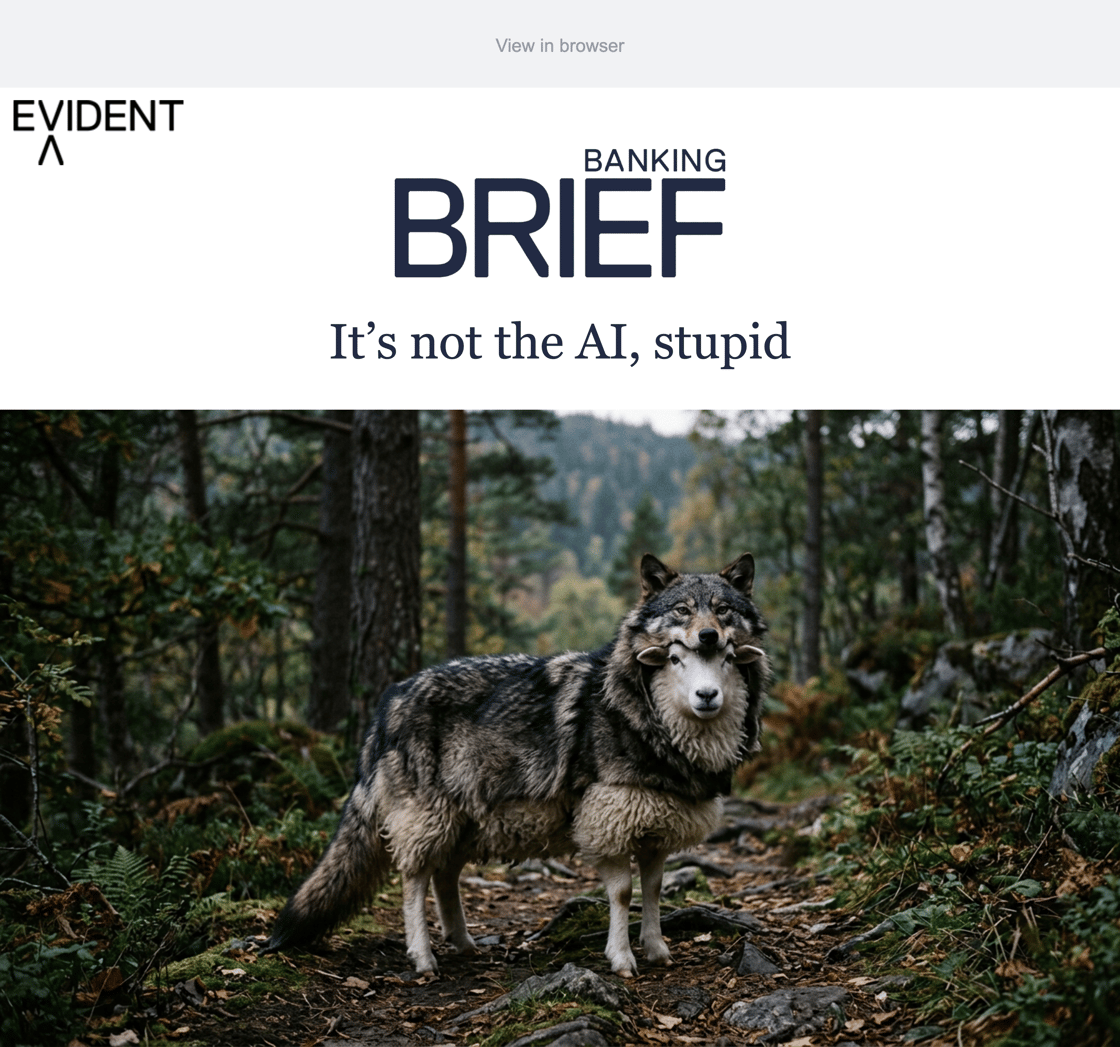
The recent string of layoffs across the banking industry is being blamed on AI. There’s a different acronym that should come to mind: BS.
Look at all the cuts piling up, in many cases with AI on the wanted poster. Nordeaplans to cut5% as it expects AI to deliver cost savings. HSBC says up to 10% of its staffcould be on the chopping blockin the next several years.
Tech is being framed. Faced with investor pressure over a fragile market, banks have learned Silicon Valley’s old trick: Put AI in the headline and people stop asking hard questions about costs, growth and management.
The fact is banks aren’t nearly good enough at AI yet to explain cuts this deep. For now, AI is helping lenders go faster. Tools are helping squeeze more output from the same people – 100,000 hoursfor developersat Citi, 1.2 million hoursfirmwideat CIBC. But they create a productivity paradox: All that extra time still can’t replace the roles altogether. Even at JPMorganChase, where 150,000 active LLM Suite users save four hours each week, CEO Jamie Dimon says it’s “not something you can directly translate into headcount reduction” (see: “Show me the money,” The Brief, Feb. 26).
When firms have tried to replace workers so far, they’ve largely failed. Klarna had tohire back customer service staff after its cost-cutting AI push led to “lower quality” interactions. On a smaller scale, CommBankwalked backjob cuts brought on by a customer service bot after complaints climbed. In each case, technology could handle pieces of the job, but it couldn’t make the cost savings stick or contain the new risks it introduced. People, they found out, remained essential.
What could justify such large-scale cuts is what banks are only just beginning to do: Rebuilding the work itself around AI. That means not just layering AI on top of what a bank already does, but “re-engineering processes for human and AI collaboration,” as DBS CEO Tan Su Shan described it this month (see: “DBS’ new success metric,” The Brief, March 12).
They’re nowhere near that yet, at least not at scale. This past week, Goldman Sachs CEO David Solomonlaid outsix “initial workstreams” where it wants to rethink around AI, ranging from KYC and client onboarding to vendor management (more on that strategy in “Use Case Corner” below). After stripping those processes back to the studs, it’ll have to repeat the same process for every other area of the bank.
Until that happens, banks aren’t really cutting jobs because of AI. They’ve just found a perfect scapegoat.
JOIN US LIVE
The three-week countdown to our next virtual roundtable starts now. Join us and senior leaders from BMO, Wells Fargo, and EY to discuss where and how banking leaders should be focusing their AI efforts in 2026. On the agenda:
Where banking leaders are prioritizing AI deployment
How strategic investment and partnership decisions are shifting over time
Where enterprise-wide ROI is really materializing – and where you can get the most bang for your buck
The conflict in the Middle East will be “short-lived, meaning weeks, not months,” BBVA CFO Luisa Gómez Bravotold investors last week. That may or may not be true, but there’s one thing you can say for sure: The war’s impact on the Gulf’s AI buildout in banking could last years.
For banks – both in the Gulf and globally – trying to turn the area into an AI Hub, the conflict poses a long-term threat. The AI talent needed to make that strategy work may no longer want to come or stay.
For years, Gulf states have laid the groundwork for an AI boom. Massive sovereign investments tolock in cheap energy, aggressivedata center buildoutsand state-backed strategies to court foreign firms have been used to position the region as a base for finance and technology. For banks, places like Dubai and Doha were pitched as new Genevas, stable bases for capital that could support AI growth.
Those efforts were working. AI use in banking could lift the GCC’s GDP 14% by 2030, research firm Finastraprojected last year. Global banks came knocking: Standard Chartered gets about 8% of its revenue from the region now, JPMorganChase analysts said this month. HSBC, meanwhile, opened a new wealth center in the UAE last September to take advantage of an area “attracting more net inflows of millionaires than any other country in the world,” Mohamed Al Marzooqi, the bank’s UAE chief executive said.
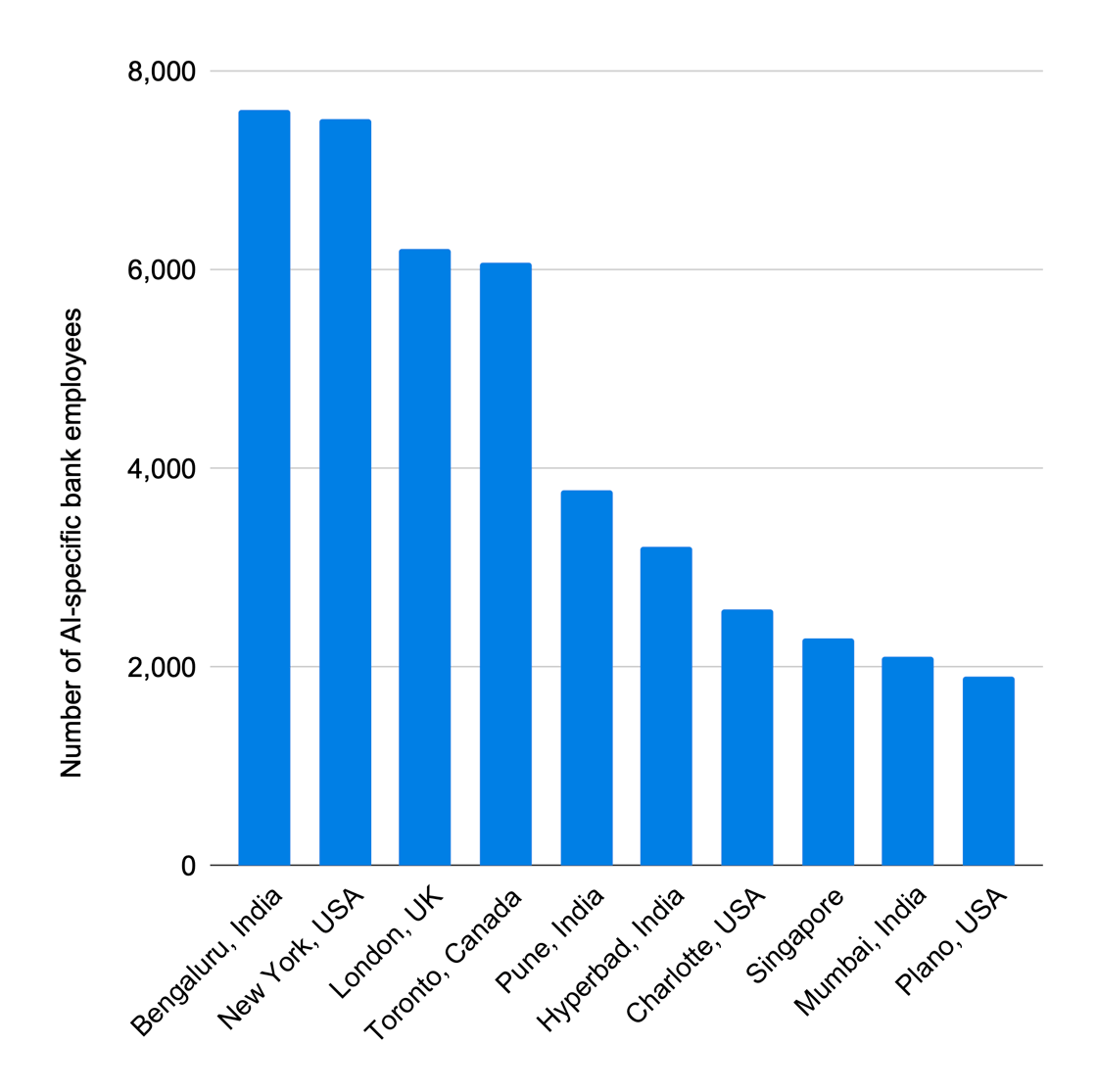
In this “If you build it, they will come” approach, talent was the missing piece. As of Q4 2025, no Middle Eastern cities cracked the top-10 global hubs for AI talent across the 50 banks tracked by Evident. Last year though, both the UAE and Saudi Arabia cracked the top-20 countries for AI talent, according to a report from the International Finance Forum.
MISSING ME
No Gulf cities were among the top-10 most lived-in places for AI talent among the 50 banks we track
Source: Evident AI Index, Oct. 2025
War may well reverse that progress and force the AI talent drawn to the region to second-guess that choice long-term. Citi and Standard Charteredshut some UAE officesthis month and evacuated employees. HSBCclosed its branches in Qatar. Even when the conflict ends, hedge fund Millennium is bracing to handle employees that don’t want to go back to Dubai by relocating themto Jersey. Even if temporary, those moves make it harder to recruit and retain the engineers banks need on the ground – especially since data sovereignty rules in the region limit remote work possibilities.
That’s not to say the Gulf’s AI push is undone. The capital is still there and the infrastructurelargely remains. When the conflict ends, banks will face a different kind of rebuild: Convincing AI talent the region is still a place worth building in.
COMING SOON: In May, we'll be launching our inaugural Evident AI Index covering banks in the Middle East & Africa (MEA). Get in touch to find out more about our first regional benchmark.
STAT OF THE WEEK
How much less frequently humans had to edit call notes when Capital One swapped a single LLM for a multi-agent system in its call center summarization tool, Milind Naphade, the bank’s SVP of AI foundations and Ritesh Soni, managing VP of the retail bank, told the crowdat last week’s Nvidia GTC conference. Instead of using one model to do everything, the bank split the job across specialized agents: An “understanding agent” works with a “reasoning agent” to list the facts. An “evaluator agent” then checks that passage for accuracy. And finally an “explainer agent” puts the summary in a format that’s easy to read. AI-written summaries were rated better on accuracy, completeness and readability than human work by annotators at the bank.
Bigger picture: Capital One is starting to treat some early AI tools as legacy tech as it makes more agentic bets. The bank recently retired a developer AI tool, Catherine McGarvey, SVP of developer experience, said in an interview last week. “We have this mindset of, it doesn’t matter how far we’ve come,” she said. “If it’s the wrong call or we learn something new that changes our behavior, we can [change].”
TALENT MATTERS
HSBC TAPS NEW AI HEAD
David Rice was namedHSBC’s first chief AI officer. Rice has been with the bank for almost two decades and was previously COO for the corporate and institutional banking unit. The move “provides clear enterprise leadership for AI adoption,” the bank’s release said. It reflects a growing push among banks to adopt a hub-and-spoke structure that lets AI strategy be set at the group level and leaves execution to the lines of business. “David will be instrumental” in empowering the firm’s employees to use AI to create personalized experiences for customers, CEO Georges Elhedery said. An HSBC spokesperson confirmed that Rice will report to both COO Suzy White and CIO Stuart Riley.
Shane Artisis now head of AI transformation and sustainable technology across non-financial risk technology at Morgan Stanley. His remit includes looking after business-facing agentic AI development, he wrote on LinkedIn.
JPMorganChaseis growingits LLM Suite team, hiring senior executive directors and VPs to work on the firm’s AI platform.
Scotiabankis hiringa head of AI and agentic engineering who will lead “the design, delivery, and enterprise-wide adoption of the full spectrum of applied AI capabilities,” across the bank.
Google DeepMindhiredBridgewaterAssociates’ chief scientist and head of AI, Jasjeet Sekhon, to be its new chief strategy officer. Sekhon helped build AIA labs, which is the hedge fund’s AI research and investment lab.
USE CASE CORNER
GOLDMAN’S GOLD MINES
In its annual report,Goldman Sachs laid out six areas for full AI-led transformation: Vendor management, sales enablement, KYC / customer onboarding, lending, enterprise risk and regulatory risk. In this week’s “Corner,” we look at a best-in-class use case in three of those areas which preview what true transformation can look like in those domains:
SALES ENABLEMENT: The clearest avenue to a bottom-line impact.
Why it’s ripe for transformation: JPMC’s 10,000 financial advisors used the tool – which offers real-time tips on how to guide clients – and closed 30% more deals as a result, the bank said. That came with the tool still acting like a helper: “It is a bit annoying…asking the agent to continuously complete tasks,” said Ajay Mehta, who leads the bank’s Connect Platform. Translation: Humans still drive the process. Once a bank’s systems go from fetching information faster to doing prep work and follow-ups on its own, 30% growth will be the floor.
KYC / ONBOARDING: Any extra time spent on the process of verifying documents takes money out of the bank’s pocket.
Why it’s ripe for transformation: The OCBC-owned private bank cut the time it took employees to draft “source of wealth” memos – which explain how prospective clients made their money – from 10 days to one hour. That’s just one small part of the KYC workflow. Leading banks can automate about 40% of the whole process (see: “KYC on auto,” The Brief, Dec. 11). But if a bank can redesign that process wholly around AI, they will move from doing KYC faster to making big chunks of the process run on its own.
VENDOR MANAGEMENT: An unsexy cost center at banks that eats up billable hours.
Why it’s ripe for transformation:BNY’s tool, developed with OpenAI, cut the length of contract review cycles by 75% for more than 3,000 contracts. That solves one bottleneck. But true AI transformation in vendor management will come from agents managing the outside vendors more holistically, taking data on risks, spending, monitoring and more that exists in disparate parts of the business and bringing it together into one streamlined process that gives the bank more control over the economics and the risks that come with bringing on new partners.
NOTABLY QUOTABLE
“There is no consensus on what AI will mean for the labor market – particularly for entry-level white-collar roles. The truth is, no one knows with certainty. In the near term, there are roles we know are in clear demand, and pay well: skilled trades, especially the ones building the physical infrastructure of AI, like data centers, power systems, and electrical grids.”
Starling Bank this weeklaunchedthe “U.K.’s first agentic AI financial assistant,” a tool it says can help app users manage their money and get personalized financial advice. The neobank’s customers can speak or write to the assistant, which can take actions – like automatically transferring money between accounts each month based on a savings goal a customer sets out. Personal finance has become a new battleground, but not all AI tools here are the same. NatWest, for example, launchedCora Spending Chat, a customer-facing agentic tool in its app which lets customers interrogate their spending. American Express (#4 in theEvident AI Index | Payments) is launching an agent that “provides deep spending insights,” CEO Stephen Squeri wrote this week in his shareholder letter. Lloydssignaledin November that it would also launch an agentic financial assistant this year; the question is whether it’ll simply surface insights in a new way or actually take actions on its customers’ behalf.
Palantir won a three-month trial contractfrom the Financial Conduct Authority, which will see the U.K.’s financial watchdog using the U.S. tech company’s software to help tackle financial crime. Palantir has seen other wins in the financial sector in recent months, with the Peter Thiel-backed firm partnering with Swiss Re in December to help the reinsurance company build an AI platform.
Bank of Americarolled out a new AI tool for investment advisors to help prepare, summarize and take further action around client meetings. “Meeting Journey” was rolled out to 25,000 advisors and is saving them up to four hours per meeting, the bank reported. It plugs into Salesforce to prepare meeting notes and Zoom to create summaries. It’s a late arrival: JPMorganChase’s Advisor Copilot and Morgan Stanley’s Debrief tools have similar functionality and were rolled out roughly two years ago.
THE BRIEF TEAM
Alexandra Mousavizadeh | Co-founder & CEO | alexandra.mousavizadeh@evidentinsights.com Annabel Ayles | Co-founder & co-CEO | annabel.ayles@evidentinsights.com Colin Gilbert | VP, Intelligence | colin@evidentinsights.com Matthew Kaminski | Senior Advisor | matt@evidentinsights.com Kevin McAllister | Senior Editor |kevin@evidentinsights.com Daniel Shackleford Capel | MD, Banking | daniel@evidentinsights.com
Contributors:
Maryam Akram | Senior Research Manager Zachary Groz | Reporter Alex Inch | Data Scientist Sam Meeson | AI Research Analyst Gabriel Perez Jaen | Senior Research Manager
.png?width=120&upscale=true&name=top-of-the-news%20(2).png)
.jpg?width=1120&upscale=true&name=Roundtable-Speakers%20(3).jpg)

.png?width=120&upscale=true&name=stat-of-the-week%20(1).png)